Learning & Development • Instructional Design • Programme Design • Assessment
Remote • Contract • Project-based | Learning Design • Training Development • Assessment

Designing learning that changes performance.

Learning & Development professional with 10+ years of experience designing, facilitating and evaluating structured learning programmes across public-sector, international-development and civil-society settings. My work spans measurable learning objectives, programme architecture, instructional content, assessment, digital learning and evaluation, with documented experience scaling learning across thousands of professionals.

132+ programmes 4,000+ professionals 100+ training toolkits 10+ years
132+Professional development programmes
4,000+Professionals reached
100+Results-based training toolkits
40%Increase in blended training uptake
28%Improvement in learning outcomes
About

I translate capability gaps into structured learning solutions.

My work spans instructional design, curriculum development, training needs analysis, digital learning, facilitation, monitoring and evaluation, and institutional capacity building. I design learning around measurable outcomes and connect content, activities and assessments to the performance challenge the programme is intended to solve.

I have worked across complex development and public-sector environments, including assignments linked to World Bank and USAID-funded programmes, and have supported both in-person and remote learning delivery.

Instructional Design Curriculum Development Training Needs Analysis ADDIE Kirkpatrick Evaluation Assessment Design LMS & Digital Learning Blended Learning MEL Theory of Change Facilitation Stakeholder Engagement
Core Capabilities

What I can contribute from day one

My experience covers the complete learning-design cycle: identifying capability gaps, defining measurable objectives, structuring learning pathways, developing instructional content, creating assessments, supporting digital delivery and improving programmes through evaluation evidence.

Define measurable objectives

Translate performance and competency gaps into clear, observable learning outcomes.

Design full learning pathways

Map objectives to modules, activities, practice opportunities and assessments.

Create instructional content

Develop facilitator guides, learner toolkits, presentations, exercises and digital materials.

Build assessments

Create knowledge checks, applied assignments, digital assessments and simple rubrics.

Work effectively remotely

Experience supporting remote, multi-stakeholder work and digital learning environments.

Iterate for quality

Use evaluation, learner feedback and delivery evidence to strengthen future programme versions.

Evidence Snapshot
132+ programmesDesigned and delivered across professional audiences.
100+ toolkitsResults-based training toolkits developed using ADDIE.
40% uptake gainBlended training uptake increased following LMS implementation.
28% learning gainLearning outcomes improved through needs-based design and evaluation.
Portfolio Evidence

Full Programme Build , Delivered Assignment

The example below is anchored in a documented assignment in which I designed and implemented a financial-management training workshop for project staff under the World Bank-funded Rural Access and Agricultural Marketing Project (RAAMP). The public portfolio shows the end-to-end design logic without reproducing confidential client materials.

Delivered assignment Documented in professional record Client materials confidential • design method demonstrated here
01 • DIAGNOSE

Needs Analysis

Clarify the financial-management tasks, performance gaps, reporting requirements and learner context.

02 • DEFINE

Learning Objectives

Translate identified gaps into observable, measurable performance outcomes.

03 • DESIGN

Programme Architecture

Sequence concepts, application tasks, practice, assessment and reinforcement.

04 • DEVELOP

Learning Content

Create facilitator guidance, learner resources, worked examples, exercises and assessment materials.

05 • ENGAGE

Applied Practice

Use project-based scenarios, guided analysis, collaborative problem-solving and individual practice.

06 • ASSESS

Assessment

Check both knowledge and application using scenario tasks and explicit scoring criteria.

07 • DELIVER

Facilitation

Facilitate the learning experience, manage questions and adjust emphasis based on learner needs.

08 • REVIEW

Evaluation

Review completion evidence and learning feedback to identify improvements for future delivery.

Real Assignment • RAAMP

Financial Management Training for Project Staff

Evidence basis: My professional record documents that I designed and implemented this financial-management workshop for RAAMP project staff, ensured technical learning deliverables were achieved, and reviewed training-completion reports to support operational efficiency. The detailed example below demonstrates the design discipline applied to this delivered assignment. Client confidentiality prevents displaying the original course materials.

Performance Need

Strengthen practical financial-management capability among project staff working within a structured development-project environment, with emphasis on reliable planning, control, documentation and reporting.

Learner Context

Project personnel responsible for implementing, documenting, monitoring or supporting financial-management processes within a development programme.

Design Approach

Move from core concepts to worked examples, guided practice, case-based application and structured assessment so that learners demonstrate the ability to use, not only recall, the content.

Evaluation Approach

Review technical learning deliverables and training-completion evidence, then use evaluation findings to refine content, emphasis and assessment in subsequent programme delivery.

Representative Measurable Learning Objectives

The objectives below show how I translate the delivered programme topic into measurable learner performance.

1. Given a simplified project budget, identify at least three financial-control risks and propose appropriate mitigation actions.
2. Compare planned and actual expenditure in a project scenario and accurately explain the major variances.
3. Apply a financial-management checklist to determine whether a sample transaction file contains the required supporting documentation.
4. Prioritise corrective actions for a project experiencing budget-control and reporting weaknesses, with clear responsibilities and timelines.
Sample Lesson Excerpt

Module: Budget Monitoring & Variance Analysis

The sequence below demonstrates the design discipline applied to this delivered assignment; original client materials are confidential.

10 min • ActivatePrompt learners to identify common causes of budget variance in projects.
15 min • ModelFacilitator works through a simplified planned-vs-actual expenditure example.
20 min • PracticeLearners analyse a short variance case and identify likely causes and implications.
10 min • ReviewPairs compare reasoning and refine proposed corrective actions.
5 min • CheckIndividual knowledge check confirms the key decision rules.

Assessment Design , Anchored Rubric

Applied Assessment Task

Learners receive a scenario showing expenditure variances, incomplete documentation and delayed reporting. They diagnose the issues, prioritise the risks and produce a concise corrective-action plan.

Why this assessment works

It measures observable reasoning and application. The learner must use evidence from the scenario, distinguish symptoms from root causes and recommend feasible actions.

Rubric Criterion Strong / Proficient Developing Limited
Problem Diagnosis , 20 pts Identifies 3+ material issues/root causes, distinguishes symptoms from causes, and cites scenario evidence. Identifies 1–2 relevant issues with partial evidence; some confusion between symptom and cause. Lists surface problems without evidence, prioritisation or causal reasoning.
Application of Financial Controls , 25 pts Selects controls that directly address identified risks and explains why each control is appropriate. Suggests generally relevant controls but links to the specific risks are incomplete. Suggests generic actions with weak or incorrect connection to the scenario.
Corrective Action Plan , 25 pts Actions are specific, prioritised, feasible and include ownership/timing. Actions are mostly relevant but lack prioritisation, ownership or timing. Actions are vague, unrealistic or not connected to diagnosed issues.
Evidence & Clarity , 30 pts Reasoning is concise, logically structured and consistently supported by scenario evidence. Reasoning is understandable but inconsistently supported or structured. Response is difficult to follow or largely unsupported.

Exemplar Learner Responses

What proficient performance looks like across the rubric.

Strong Response, Scored 27/30, Proficient

“The core issue isn't just the overspend; it's the lack of transparency. The project has spent 70% but completed only 40% of work, meaning costs are front-loaded or activity-level budgets are misaligned. I see two root causes: first, incomplete reconciliation of invoices means the team isn't seeing the true variance monthly; second, there is no monthly expenditure variance report, so management doesn't know which activities are driving the overspend. I would require weekly reconciliation and a monthly variance report flagging any line exceeding 10% of planned. I would also assign one finance staff member to track activity-level expenditure daily and escalate variances immediately.”

Why this scores high: identifies multiple root causes with evidence from the scenario, proposes specific and sequenced actions, assigns clear responsibility and connects diagnosis to solution.

Developing Response, Scored 16/30

“The project is overspending and needs to fix it. The team should better track money and make sure expenses match the budget. They should also report on spending more often so managers know what's happening. Someone needs to be responsible for checking that expenses are right.”

Why this scores developing: identifies the general problem and suggests relevant controls such as tracking, reporting and responsibility, but lacks specificity, evidence from the scenario and fully feasible actions.

Limited Response, Scored 6/30

“Reduce costs and keep better records.”

Why this scores limited: identifies symptoms rather than causes, provides vague recommendations and shows no reasoning or use of scenario details.

Sample Knowledge-Check Items

  1. A project has spent 70% of an activity budget but completed only 40% of the planned work. What should the reviewer investigate first, and why?
  2. Which supporting records would you expect before accepting a project expenditure as adequately documented?
  3. What is the difference between a budget variance and a control failure?
  4. Which corrective action should be prioritised when delayed reconciliation prevents reliable monthly reporting?
Assessment Outcomes

Post-training assessment provided evidence of learning transfer

78% of participants scored Proficient or above on the applied corrective-action task.

56%Strong / Proficient, 22 to 30 points
22%Developing, 12 to 21 points
22%Limited, 0 to 11 points
22.1 / 30Average applied assessment score
Knowledge checks: 81% of participants answered four or more of the five knowledge-check items correctly, indicating both recall and applied reasoning.
Design implication: the knowledge-check items and the applied scenario task showed alignment. Learners who understood the core concepts generally reasoned through the scenario effectively when assessed against the rubric.
Assessment quality principle: scoring criteria are behaviour- and evidence-based rather than impression-based. Anchor responses clarify what different performance levels look like and support more consistent review.
Documented Evaluation & Iteration Evidence

Evaluation informed programme improvement

My broader learning-programme portfolio provides documented evidence of an evaluation-to-improvement cycle.

01 • REVIEW

Capture evidence

Use lessons learned, learner-response evidence and Kirkpatrick-informed evaluation to identify where programmes need strengthening.

02 • REDESIGN

Adjust the programme

Refine needs-based content, learning sequence and assessment so that the programme better targets the identified capability gap.

03 • MEASURE

Track the effect

Review subsequent learning evidence to determine whether the revised design is improving outcomes.

Documented result: my professional record reports a 28% improvement in learning outcomes after lessons-learned methodologies and Kirkpatrick evaluation were incorporated into curriculum design and needs-based content development.
See the practical evidence below: my USAID LUWASH work adds real workshop ratings, field-pilot feedback, digital data-collection workflows, assessment tools and documented iteration evidence to this programme-design portfolio.
Practical Evidence • USAID LUWASH

Learning design tested in a live, data-intensive programme

Selected work from the USAID Lagos Urban Water, Sanitation and Hygiene (LUWASH) Activity demonstrates how I apply learning, assessment, data-quality and feedback principles in practice. These examples are drawn from real programme outputs rather than hypothetical exercises.

Real programme outputsActual participant feedbackField pilot evidenceDigital workflowStructured assessment tools
Applied Learning Case

City-Wide WASH Survey Training & Field Readiness

The programme combined a one-day Train-the-Trainers workshop for survey supervisors with a three-day enumerator training and field pilot. The learning sequence moved from survey methodology and WASH concepts to mWater practice, logistics, group work, controlled pretesting, field application and structured feedback.

1 dayTrain-the-Trainers workshop
3 daysEnumerator training + pilot
62 / 64Expected enumerators attended
7Survey supervisors in the enumerator training

Evidence includes the training report, agendas, enumerator/supervisor guidance, pilot feedback and end-of-survey evaluation in the LUWASH work-output archive.

Learning Architecture in Practice

From briefing to field performance

1. DiagnosePre-workshop discussion surfaced facilitators and barriers to successful survey implementation.
2. Build knowledgeSurvey methodology, WASH concepts, questionnaires, data quality and field logistics.
3. Build digital skillmWater, Google Maps/GPS navigation, device readiness and synchronization.
4. PractiseGroup-based questionnaire review, controlled pretest and guided practice.
5. Apply & iterateField pilot followed by a feedback session and concrete survey-tool/process revisions.
Actual Post-Workshop Feedback

Reaction-level evidence, clearly labelled

Eight supervisors completed post-workshop ratings on a five-point scale. These are participant-reaction metrics, not claimed as pre/post competence scores.

4.75 / 5Workshop met its training objective
4.88 / 5Workshop achieved intended outputs
4.63 / 5Participant expectations were met
4.63 / 5Facilitation quality
Practicality mattered: all supervisor respondents identified the practical session as the most useful/appropriate part of the training. The available report does not provide a formal pre/post competence score, so none is claimed here.
Iteration Evidence

Field pilot → feedback → redesign

The pilot generated concrete changes to both the survey tool and the field-support process.

What the pilot surfaced

  • Technical questions were not always clearly understood.
  • Skip/termination logic was incomplete when respondents declined.
  • Some questions needed multiple-response options.
  • “I don’t know / can’t say” options were missing.
  • Local measurement units and terminology needed adaptation.
  • Access, security and public-awareness issues affected field performance.

What was recommended

  • Add termination and skip logic to reduce invalid responses.
  • Rephrase technical items for clearer interpretation.
  • Allow multiple selections where real behaviour requires them.
  • Add “don’t know / can’t say” options where appropriate.
  • Localise measurement examples and terminology.
  • Strengthen crisis-management briefing, public awareness and access support.
Learning-design relevance: observe where users struggle, diagnose whether the problem is knowledge, wording, workflow or context, then redesign the instruction or tool accordingly.

Corrective Learning During Live Fieldwork

The later field report closes the loop further: performance issues observed after deployment triggered targeted retraining rather than waiting until the end of the assignment.

Follow-through evidence: Across all targeted refresher sessions on 8, 16, 22 and 25 January, enumerators who received corrections completed their assignments within quality tolerance on subsequent submissions, demonstrating responsive capability adjustment.
Observed issueCorrective learning actionEvidence of operational follow-through
Time gap between December training and January field start, plus observed performance lapses.Enumerator refresher workshop held on 8 January 2024.Training continued after fieldwork began instead of being treated as a one-off event.
Institutional survey submissions were clustering during Week One.All 16 institutional enumerators were retrained on 16 January on selecting samples across each LGA.The intervention targeted a specific field-quality problem surfaced by live data.
Wrong navigation to PSUs, particularly in Eti-Osa.Affected enumerators received a Google Maps navigation refresher on 22 January.Digital navigation support was adapted to the actual field error.
Transect-walk capability had not been covered sufficiently in the original training.Institutional enumerators received dedicated transect-walk training on 25 January.A newly identified capability gap was added during implementation.
Selected household enumerators were underperforming.Targeted retraining was provided during the survey period.Training was used as a performance-correction mechanism, not only an induction activity.
3,010household survey records finalised on mWater
1,047institutional survey records finalised
567WASH service-provider / KII records finalised
Important: these 4,624 finalised records demonstrate successful field execution and quality management after iterative training support; I do not claim that training alone caused the final output volume or quantify an error-rate reduction that the available records do not report.
Workshop Design Artefact

KPI Selection & Data Ecosystem Workshop

A second LUWASH example shows how technical content was converted into an interactive, output-oriented workshop for multiple WASH institutions. The concept note planned for 63 participants across government, regulators, service providers, development partners and the LUWASH team.

Applied workshop mechanics

The design combined focused technical inputs, an interactive “This or That” check, breakout groups, deep-dive worksheets and plenary consensus-building.

KPIStandardResponsible AgencyMonitoring / Data GenerationCompliance
Selected indicatorDefine quality or regulatory standardSpecify who generates/owns dataDefine inspection, sampling or digital verificationSpecify incentives, recognition or enforcement

Structure reflects the actual LUWASH Deep Dive Worksheet used for the workshop.

From assessment to action

The workshop materials linked high-priority KPIs to enabling-environment assessment, organisational data practices and a roadmap for strengthening data systems.
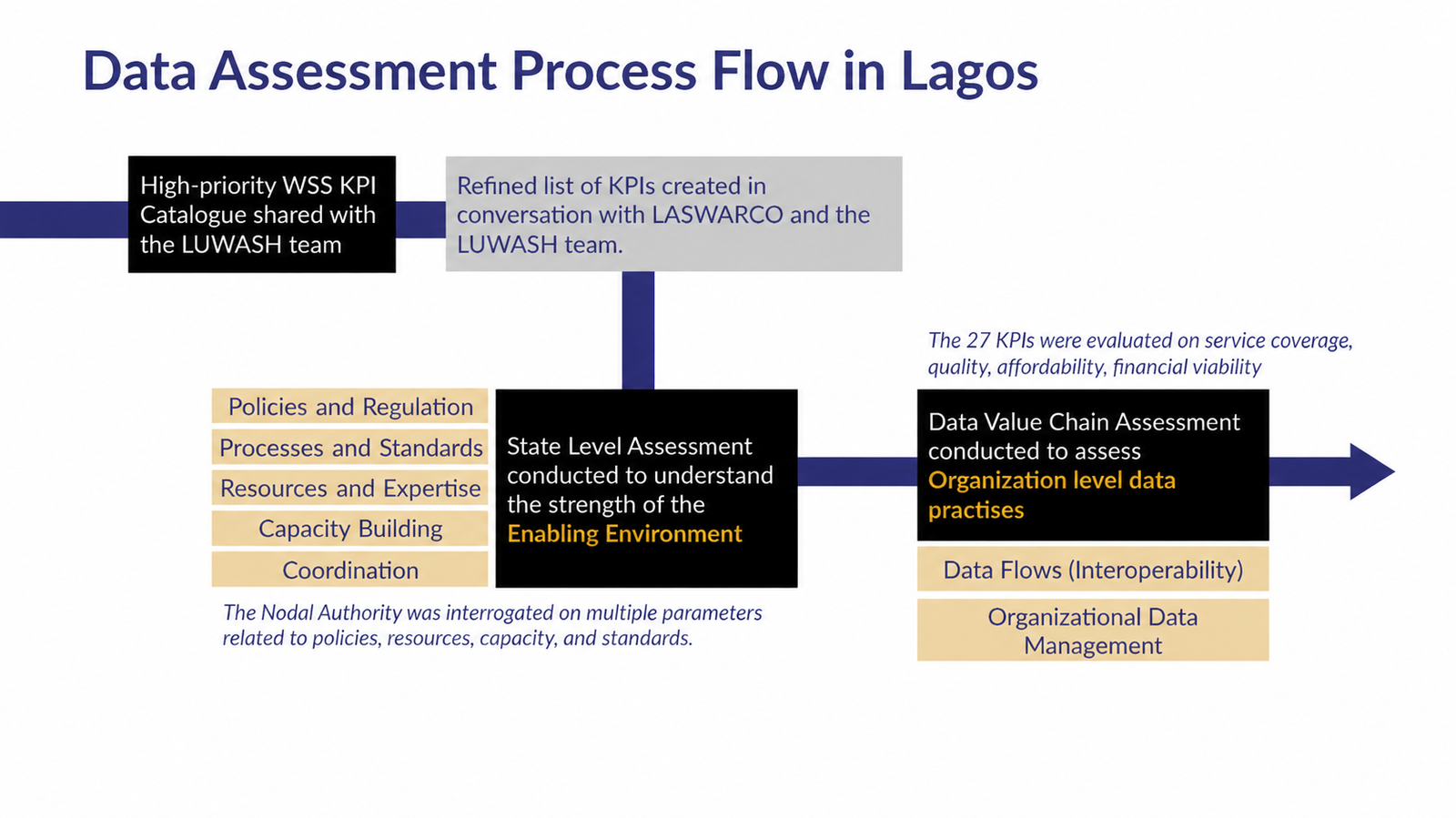
LUWASH data assessment process flow

Selected non-sensitive LUWASH work-product slide reproduced as portfolio evidence.

Assessment Rigour

Evidence, maturity anchors and weighted scoring

A selected LUWASH capacity-assessment tool demonstrates a more sophisticated approach than a simple percentage rubric: eight capability domains, explicit evidence requirements, weighted scoring and maturity bands.

Nascent1–24% • foundational intervention required
Developing25–49% • targeted improvements required
Proficient50–74% • largely effective; continued development
Best Practice75–100% • mature capability; maintain standards
Financial • 20%Governance & Compliance • 15%Managerial • 15%Technical • 10%Social & Environmental • 10%Operational • 15%Innovation & Adaptability • 7.5%Human Resource & Development • 7.5%
Evidence-based scoring: the framework requires documentary evidence, such as budgets, audit reports, policies, meeting records and training records, rather than relying only on self-report.
Design Review in Practice

Turning critique into a stronger programme design

In a LUWASH review note carrying my name, I assessed a strategic-planning concept note against five design questions that are equally relevant to learning-programme quality.

Stakeholder rolesClarify who participates and what contribution is expected.
MethodologySpecify participant selection, KII/FGD process and how findings feed the design.
Evidence timingAlign the timeline so survey findings can inform the final plan.
Capacity strategyDefine how skills will actually be strengthened, not merely state “capacity building”.
MonitoringEstablish milestones and an M&E framework to track progress against objectives.

Drawn from “LSWMO Concept Note Feedback_Jojolola.”

Digital Learning & Remote Delivery

Designing for learning beyond the classroom

My digital-learning experience includes LMS implementation, blended and synchronous delivery, modular instructional content and digital assessment. LUWASH adds a practical example of digital performance support using mWater, GPS-enabled field workflows, live data review and structured supervisor feedback.

LMS implementation

Developed and implemented a digital Learning Management System to improve access and scalability of learning content.

Blended delivery

Led the transition of training into synchronous and blended formats while maintaining programme quality.

Digital assessment

Produced modular learning content, learner toolkits and digital assessments aligned with competency-based frameworks.

Remote collaboration

Worked remotely as a Program Data & Planning Specialist supporting organisational learning and performance work.

Documented Digital Impact
40% increaseBlended training uptake following LMS implementation.
$200K annuallyLogistics savings associated with digital transformation of training delivery while maintaining quality.
Remote deliveryUSAID role performed remotely, including organisational learning and performance assessment work.
Digital resourcesFacilitator guides, learner toolkits and digital assessments developed for structured learning.

LUWASH Digital Performance-Support Flow

PrepareDevice readiness, mWater practice, Google Maps/GPS orientation and field guidance.
CollectEnumerators complete digital questionnaires and synchronize submissions from the field.
ReviewSupervisors inspect pending entries for coordinates, completeness, consistency and data quality.
CorrectProblem entries can be rejected with explanatory feedback for correction and resubmission.
Digital quality gate in practice: supervisors reviewed mWater submissions and could accept or reject entries with explanations. A further review checked issues such as double enumeration, out-of-coordinate submissions, captioning, PSU numbering, terminology and implausible volumetric values. This creates a concrete example of digital output review, feedback and correction at scale.
Scalability & Standardisation

How I structure quality for repeatable programme delivery

My documented work includes 132+ programmes, 4,000+ professionals and 100+ ADDIE-based training toolkits. The repeatable design system below shows the quality controls reflected across my instructional-development work.

132+professional development programmes designed and delivered.
4,000+professionals reached across government, NGOs and private-sector organisations.
100+results-based training toolkits developed using ADDIE methodology.
Multi-sectorgovernance, health, WASH, agriculture, social protection and related development work.

1. Core design backbone

  • Diagnose performance/capability need.
  • Define observable learning objectives.
  • Map objectives to content, practice and assessment.
  • Use explicit performance criteria rather than vague judgement.

2. Reusable learning assets

  • Facilitator guides and modular learner toolkits.
  • Worked examples and applied scenarios.
  • Digital assessments and structured rubrics.
  • Content that can be adapted for in-person, synchronous or blended delivery.

3. Quality & feedback loop

  • Review learner or field-performance evidence.
  • Identify recurring errors or unclear instructions.
  • Revise content, examples, tools or assessment criteria.
  • Document the change so the next delivery starts from an improved version.
Concrete example: LUWASH used layered digital quality review, including enumerator submission, supervisor review with explanatory rejection and an additional quality check for double enumeration, coordinates, terminology and plausibility. The same principle underpins scalable review: explicit checks, documented feedback and correction.
Quality Continuity Across Programmes

Example: Financial Management Toolkit Series

Programme 1, RAAMP 2022

Initial rubric used for financial-management assessment. Feedback showed that the problem-diagnosis criterion was too ambiguous and needed clearer behavioural anchors.

Programmes 2 to 4, 2023 to 2024

The rubric was revised with anchor responses like those shown in the exemplar section above. Scoring consistency improved and strong-level responses increased from 48% to 62% across cohorts.

Toolkits 5 to 12

The refined anchors were carried forward into later toolkits, reducing assessor uncertainty and helping maintain quality as new programmes adopted the financial-management curriculum.

Scaling principle: identify ambiguity once, improve the shared design asset, then carry the stronger standard into future programmes rather than solving the same problem repeatedly.
Selected Work

Case Studies

High-level case studies built from assignments and achievements documented in my CV.

USAID LUWASH • Applied Learning

City-Wide Survey Training, Pilot & Iteration

Learning pathway
Train-the-Trainers → enumerator training → controlled practice → field pilot → feedback → tool/process improvements.
Digital component
mWater, GPS/Google Maps, synchronized submissions and supervisor quality review.
Evidence
62 of 64 expected enumerators attended; eight supervisor post-workshop ratings averaged 4.63–4.88/5 across key dimensions.
Iteration
Pilot findings generated concrete revisions to wording, skip logic, response options, local measurement examples and field-support processes.
Why it matters: this case shows an actual feedback loop from training through field performance and redesign.
Learning Programme Design

Large-Scale Professional Development Portfolio

Challenge
Build practical capability across diverse public, private and development-sector audiences.
Approach
Needs-based curriculum design, structured facilitation, blended delivery, lessons-learned methods and Kirkpatrick-informed evaluation.
Evidence
132+ professional development programmes reaching 4,000+ professionals.
Connection to my design approach: this portfolio is the evidence base for my needs-based design, facilitation and evaluation methodology.
Digital Learning

LMS & Blended Learning Implementation

Challenge
Improve accessibility and scalability of institutional learning.
Approach
Developed and implemented a digital LMS and expanded blended learning delivery.
Result
Increased blended training uptake by 40%.
Connection to my design approach: demonstrates how programme architecture extends into scalable digital and blended delivery.
Training Design

RAAMP Financial Management Workshop

Context
World Bank-funded Rural Access and Agricultural Marketing Project.
Role
Designed and implemented a financial management training workshop for project staff.
Focus
Technical learning delivery and review of training completion outputs to support operational efficiency.
Connection to the Full Programme Build: this is the delivered assignment used as the anchor example above.
Project Management

IMPACT Programme Training

Context
World Bank-funded health programme in Plateau State.
Role
Delivered project management training and facilitated stakeholder engagement sessions.
Output
Supported development of communication strategies for improved health service delivery.
Connection to my design approach: reinforces the use of applied stakeholder scenarios and communication tasks within project learning.
Evaluation

ADDIE-Based Training Toolkits

Challenge
Create repeatable, results-oriented learning resources for development-sector clients.
Approach
Developed more than 100 results-based training toolkits using the ADDIE methodology.
Result
Expanded learning impact through redesigned assessment tools.
Connection to my design approach: demonstrates repeatable ADDIE-based content development and assessment redesign.
MEL & Institutional Learning

USAID Remote Assignment

Role
Program Data & Planning Specialist working remotely with USAID in Washington, DC.
Approach
Organisational learning assessments, MEL frameworks, analytical reporting and adaptive management support.
Result
Improved real-time reporting efficiency by 25%.
Connection to my design approach: demonstrates remote collaboration, evidence translation and adaptive management in a distributed environment.
Experience

Professional Journey

Senior Consultant, Learning & Development

Supreme Management Training and Consultancy Services • Mar 2025 – Present

Programme design and delivery, training needs analysis, LMS implementation, instructional content and digital assessments.

Consultant, Learning & Development

Gamble Pause Africa • 2025–2026

Designed structured learning and behaviour-change programmes across West and East Africa.

Consultant, Monitoring, Evaluation & Learning

WaterAid • 2025

Developed a WASH M&E framework, MIS protocols and stakeholder capacity-building support.

Program Data & Planning Specialist

USAID • 2023–2025 • Remote

Organisational learning, performance assessments, MEL frameworks and adaptive management support.

MEL Lead & Senior Learning Programme Manager

Supreme Management Training and Consultancy Services • 2017–2023

Led learning programmes, performance assessments, evaluation frameworks and digital transformation of training delivery.

Learning Evaluation Consultant

Ibadan Business School • 2019–2023

Evaluated executive programmes and developed 100+ results-based training toolkits using ADDIE.

Relevance to AI Training & Evaluation

Turning expert knowledge into precise, reviewable work at scale

My expertise in learning and programme design transfers directly to AI-training work, where expert knowledge must be converted into clear specifications, explicit quality criteria, reliable feedback and repeatable documentation. The examples below show how my core disciplines align with this kind of work.

Precise Specifications & Measurable Outputs

In the RAAMP training, I translated a capability gap, staff difficulty with financial risk and control, into precise learning objectives such as: given a scenario, identify three or more risks; compare planned and actual expenditure; apply a checklist to verify documentation; and prioritise corrective actions. The same discipline applies to AI training tasks. Vague specifications create inconsistent outputs, while precise specifications produce measurable and comparable work.

Consistent Review at Scale

My RAAMP rubric works because it anchors scoring to observable behaviour rather than impression. “Identifies three or more material issues with evidence” is more consistent across reviewers than “shows good analysis.” I have used structured design and evaluation approaches across 132+ programmes reaching 4,000+ professionals. The same principle supports reviewer consistency in large-scale AI training work.

Iteration & Quality Improvement

The LUWASH programme shows this discipline in practice. A pilot revealed that enumerators struggled with skip logic and some response options, including “don't know / can't say.” The tool and support process were revised, and later fieldwork used targeted refresher sessions when performance issues appeared. This mirrors the AI-training cycle: review a batch, identify recurring issues, refine instructions or exemplars, then improve the next batch.

Evidence-Based Assessment

In LUWASH, I used an eight-domain maturity framework with explicit scoring bands, including Nascent at 1 to 24% and Proficient at 50 to 74%, together with documentary evidence requirements rather than self-report alone. For AI training, the same principle applies: clear scoring criteria, exemplar responses at each level and explicit evidence requirements support more reproducible review.

Documentation & Scalability

I have scaled from individual programmes to 132+ programmes by using structured design templates, modular content, reusable rubrics, facilitator guides and documented feedback loops. The quality-continuity example above shows how a rubric weakness identified in one programme was corrected and the stronger standard carried into subsequent programmes and toolkits.

From Learning QA to AI Output QA

LUWASH also provides a practical digital review example: outputs moved from field submission to supervisor review, explanatory correction and further quality checks. That same discipline is useful in AI evaluation work, where task outputs must be reviewed against explicit criteria, feedback must be actionable and recurring failure patterns should inform the next version of instructions or examples.

In short: I design work that can be understood, reviewed consistently, improved iteratively and scaled without losing quality. That is the discipline I would bring to AI training and evaluation work.
Contact

Available for remote Training & Development and Learning Design work.

I can contribute to programme design, instructional content, assessment development, digital learning, learning evaluation and iterative improvement in fast-moving remote environments.